August 25, 2026
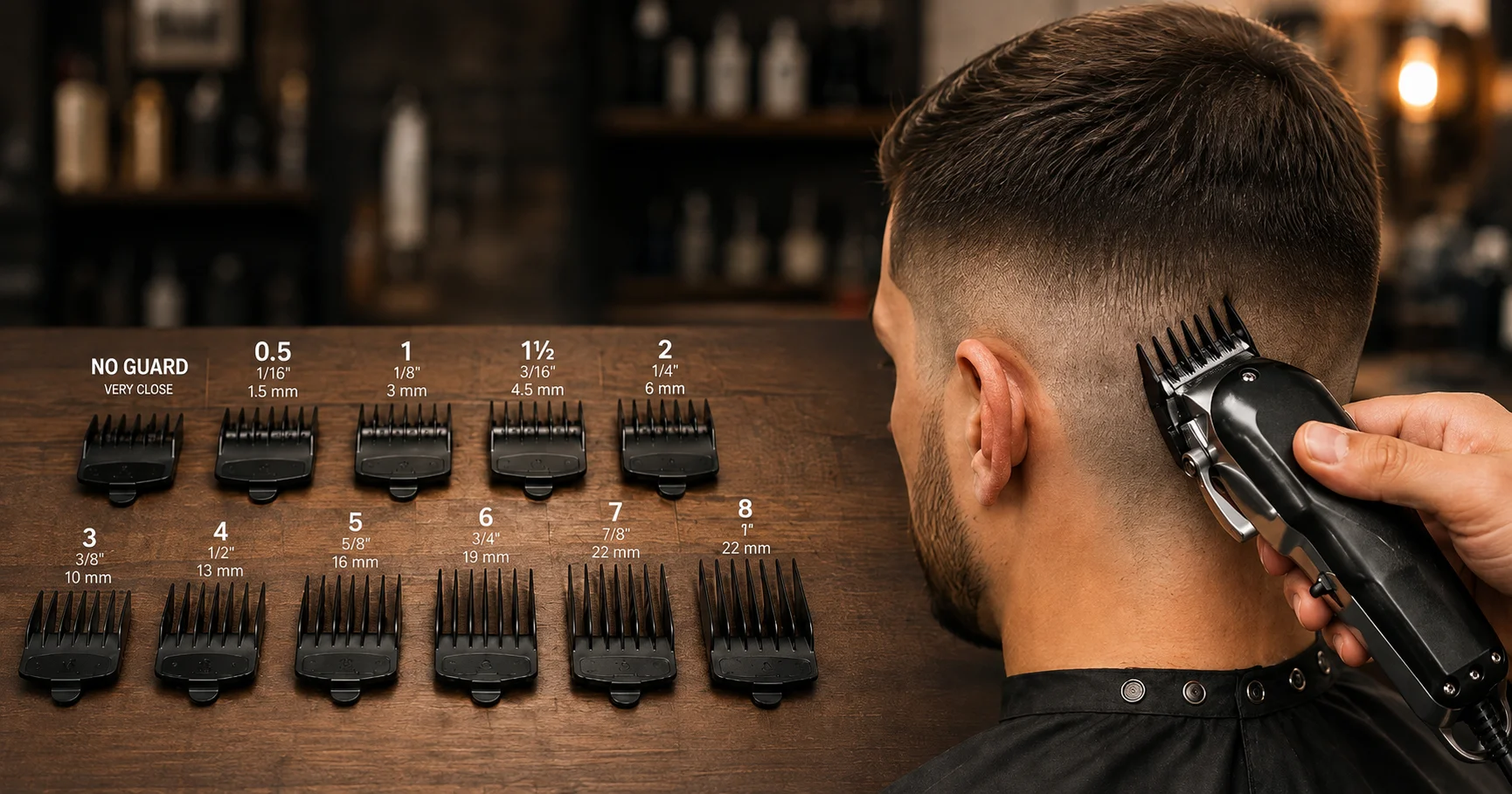
Hair clipper guard sizes are numbered attachments that control how short clippers cut your hair. A #1 usually leaves about 1/8 inch, a #2 leaves 1/4 inch, and the sizes increase up to a #8, which leaves about 1 inch. The higher the guard number, the more hair stays on your head.
At HQ Barbershop in Oak Lawn, Dallas, clients ask about guard numbers every day. Some already know they want a #2 on the sides, while others bring a photo and want us to choose the right length.
This guide explains the common clipper guard sizes, what each number means, and how to choose the right one for your haircut.
What do clipper guard numbers mean?
A clipper guard is a comb-shaped attachment that sits over the clipper blade. It controls how close the blade can get to your scalp and therefore how much hair gets removed.
The basic rule is simple:
- Lower guard number = shorter hair
- Higher guard number = longer hair
For example, a #1 leaves about 1/8 inch of hair, while a #4 leaves about 1/2 inch.
Guard numbers are useful when talking to your barber, but they are only part of the haircut. Barbers also adjust the clipper lever, blend different guards, and use different lengths around the sides, back, and top. If you want to understand the full technique, read our guide on what a clipper cut is.
Hair clipper guard size chart

Here are the most common hair clipper guard sizes and the approximate length each one leaves.
| Guard size | Length in inches | Approx. length in mm |
| No guard | Very close | Varies |
| #0.5 | 1/16 inch | 1.5 mm |
| #1 | 1/8 inch | 3 mm |
| #1.5 | 3/16 inch | 4.5 mm |
| #2 | 1/4 inch | 6 mm |
| #3 | 3/8 inch | 10 mm |
| #4 | 1/2 inch | 13 mm |
| #5 | 5/8 inch | 16 mm |
| #6 | 3/4 inch | 19 mm |
| #7 | 7/8 inch | 22 mm |
| #8 | 1 inch | 25 mm |
These measurements can vary slightly depending on the clipper brand, blade, and lever position. Still, this chart gives you a reliable idea of how each guard compares.
What does each clipper guard size look like?
Knowing the number is useful, but what really matters is how the haircut will look.
#0.5 and #1 guards
These are very short settings.
A #0.5 leaves roughly 1/16 inch and is mainly used for close fades and blending. A #1 leaves about 1/8 inch and creates a tight, clean finish where the scalp may still show through.
Both are common around the lower section of short fades and buzz cuts.
#1.5 and #2 guards
A #1.5 is a transition guard that helps barbers blend between a #1 and #2.
A #2 leaves about 1/4 inch and is one of the most popular choices for short men’s haircuts. It stays close and clean but usually gives more coverage than a #1.
It works well for buzz cuts, short sides, fades, and crew cuts.
#3 and #4 guards
A #3 leaves around 3/8 inch, while a #4 leaves about 1/2 inch.
These lengths look fuller and show less scalp. They’re good choices if you want a short haircut without going extremely close.
A #4 can also work well for longer buzz cuts or as part of a crew cut.
#5 and #6 guards
A #5 leaves about 5/8 inch and a #6 leaves about 3/4 inch.
These guards keep noticeably more length and create a softer clipper finish. They are useful when you want to remove bulk while still keeping your hair fairly full.
At this point, your barber may also combine clipper work with scissors to improve the shape.
#7 and #8 guards
A #7 leaves around 7/8 inch and a #8 leaves roughly 1 inch.
These are among the longest guards found in standard clipper sets. They work best for men who want a longer, uniform clipper cut rather than a very short buzz.
Once the hair gets much longer than this, scissors usually provide more control over layering and texture.
Which clipper guard size should you choose?
The best guard depends on how short you want your haircut and how much scalp you want showing. For a very close cut, a #1 keeps the hair tight to the head. A #2 or #3 gives you a clean short haircut with more coverage. A #4 through #6 works better when you want a fuller finish.
Your hair type also matters.
Thick, dark hair can look fuller at a short guard length, while fine or lighter hair may show more scalp at the same number. Curly and textured hair can also sit differently after being cut.
That is why we recommend thinking about the finished look instead of focusing only on a guard number. If you are still choosing a style, our guide to the types of clipper cuts for men covers buzz cuts, fades, tapers, crew cuts, and other popular options.
What guard sizes are used for a fade?
A fade usually uses several guard sizes instead of just one.
Your barber gradually moves from a shorter length at the bottom to longer hair higher up the head. A fade might include no guard, #0.5, #1, #1.5, #2, and longer settings depending on the style.
The exact combination depends on whether you want a low, mid, high, or skin fade. The most important part is not just choosing the guards. It is blending the different lengths smoothly so there are no visible lines.
For more detail, read our guide to the best clipper guard length for a fade.
Does the clipper lever change the length?
Yes.
Professional clippers often have an adjustable lever that moves the blade slightly closer or farther from the guard. This gives the barber small length adjustments without changing attachments.
That is why you may hear terms such as “lever open” or “lever closed” during a haircut. These small adjustments help remove lines between guard sizes and create a smoother blend.
It also means a #2 haircut may look slightly different depending on the clipper, lever position, and barber’s technique.
How to ask your barber for the right guard size
If you already know the length you like, you can simply say something like:
“Give me a #2 on the sides.” But you do not need to memorize clipper numbers before your appointment.
Instead, tell your barber:
- How short you want the sides and back
- Whether you want to see scalp
- How much length you want on top
- Whether you want a fade, taper, or even length
Bringing a photo is even better. A reference image helps your barber understand the overall shape, fade height, texture, and contrast you want. From there, we can choose the correct guard instead of guessing.
Our guide on how to ask for a men’s haircut explains what to discuss before your cut starts.
Frequently asked questions
Q1. What is the most common hair clipper guard size?
Answer: #2 and #3 are two of the most common sizes for short men’s haircuts. A #2 leaves about 1/4 inch, while a #3 leaves around 3/8 inch. Both keep the hair short without cutting as close as a #1.
Q2. Is a #1 or #2 guard shorter?
Answer: A #1 is shorter. It leaves approximately 1/8 inch of hair, while a #2 leaves around 1/4 inch. The difference may sound small, but it is easy to see on a short haircut.
Q3. What guard should I use for a buzz cut?
Answer: Buzz cuts commonly use guards from #1 through #4. A #1 gives a very close result, a #2 stays short with more coverage, and #3 or #4 creates a fuller buzz cut. The best size depends on your hair density and how much scalp you want showing.
Q4. What is the longest standard clipper guard?
Answer: A #8 is commonly the longest guard in a standard set and leaves roughly 1 inch of hair. Some manufacturers offer longer attachments, but once you move much beyond an inch, scissors often give better control over the shape.
Q5. Do higher clipper guard numbers mean longer hair?
Answer: Yes. In standard guard systems, the number rises with the amount of hair left behind. A #1 cuts shorter than a #2, a #2 cuts shorter than a #3, and so on. Your barber can then use the clipper lever to make smaller adjustments between those lengths.
Book a clipper cut in Dallas
Understanding hair clipper guard sizes can make it easier to explain how short you want your haircut, but you do not need to know every number before sitting in the chair.
Tell us the look you want, show us a photo, or give us the guard number you normally use. Our barbers will choose the right setting based on your hair type, density, and finished style.
That’s how we approach clipper work at HQ Barbershop on Oak Lawn Avenue in Dallas. The guard controls the length, but the blending and detail are what make the haircut look finished.
Book your clipper cut in Dallas and let our barbers find the right length for you.