August 25, 2026
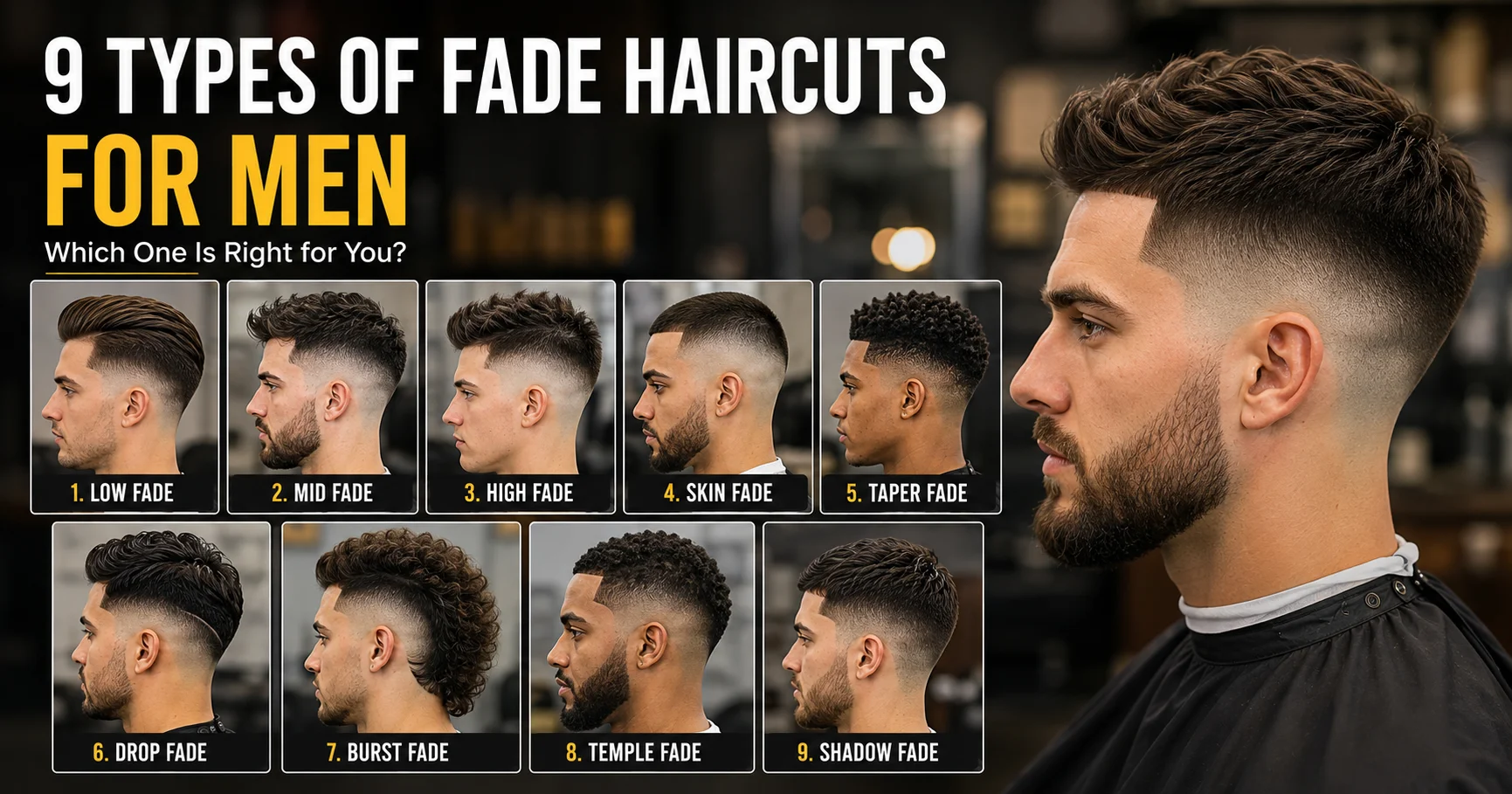
The main types of fade haircuts include low, mid, high, skin, taper, drop, burst, temple, and shadow fades. The difference comes down to where the fade starts, how short it gets, and the shape it follows around your head. The right fade should match your hair type, face shape, and how much contrast you want.
At HQ Barbershop in Oak Lawn, Dallas, fades are among the most requested haircuts we do. Some clients already know exactly what they want, while others show us a photo and ask which type of fade will work best with their hair.
That is completely normal. Fade names can get confusing because low, mid, and high describe the height of the fade, while terms like skin, drop, burst, and shadow describe how the fade is cut or shaped.
Below, we break down nine popular types of fade haircuts and explain who each one suits.
What Is a Fade Haircut?
A fade haircut gradually changes from shorter hair around the sides and back into longer hair higher on the head. Instead of leaving a hard line between two lengths, the barber blends them together for a smooth transition.
The fade can start low near the ears, higher around the temples, or somewhere in between. It can also finish at skin level or leave a little visible hair at the shortest point. That flexibility is what makes fades work with so many men’s hairstyles, from buzz cuts and crew cuts to textured crops, quiffs, curls, and longer styles on top.
If you want to understand the cutting process itself, our guide on how to do a fade haircut explains the guards, guidelines, and blending techniques behind the finished result.
What Are the Different Types of Fade Haircuts?
The nine common types of fade haircuts are low, mid, high, skin or bald, taper, drop, burst, temple, and shadow fades.
Here is the quick difference between them.
| Fade type | Where or how it fades | Overall look | Best for |
| Low fade | Starts near the ears | Subtle and clean | Professional styles |
| Mid fade | Starts around the middle | Balanced | Most hairstyles |
| High fade | Starts near the temples | Bold contrast | Short, sharp styles |
| Skin fade | Drops to bare skin | Very sharp | Modern high-contrast cuts |
| Taper fade | Focused around edges | Soft and classic | Conservative looks |
| Drop fade | Curves lower behind ears | Sculpted | Curly and textured styles |
| Burst fade | Curves around the ear | Bold and rounded | Mullets and mohawks |
| Temple fade | Focused at temples | Clean and controlled | Curly and Afro-textured hair |
| Shadow fade | Keeps slight hair at bottom | Soft gradient | Men avoiding exposed scalp |
The important thing to remember is that these categories can overlap. For example, you can have a low skin fade, a mid drop fade, or a high shadow fade.
1. Low Fade

A low fade starts close to the ears and neckline, keeping most of the sides relatively full before gradually getting shorter near the bottom.
Because the transition starts lower, this is one of the most subtle fade options. It gives you a clean outline without creating a dramatic contrast between the sides and the top.
Low fades work especially well with medium-length hair, side parts, quiffs, textured tops, and classic professional styles.
If you want your haircut to look polished without making the fade the main feature, a low fade is usually a safe place to start.
2. Mid Fade

A mid fade begins higher than a low fade but lower than a high fade, usually around the middle of the sides. This makes it one of the most balanced and versatile fade haircuts. You get more contrast than a low fade, but it still avoids the very exposed look of a high fade.
Mid fades pair well with crew cuts, textured crops, pompadours, curls, and short-to-medium styles on top.
For clients who are not sure which fade height to choose, a mid fade often gives us enough structure to sharpen the haircut without pushing it too far in either direction.
3. High Fade

A high fade starts near the temples and removes much more hair from the sides and back.
The result is a strong contrast between the short sides and whatever length you keep on top. That makes the high fade feel sharper and more noticeable than a low or mid fade.
It works well with buzz cuts, short crops, textured tops, and styles where you want the top of the haircut to stand out.
A high fade can also visually create more height through the top, which may suit some rounder face shapes. The tradeoff is that the sides grow out more noticeably, so you may want more frequent maintenance.
4. Skin Fade or Bald Fade

A skin fade, often called a bald fade, takes the shortest part of the haircut all the way down to bare or nearly bare skin. The barber then blends upward into progressively longer lengths, creating one of the cleanest and sharpest finishes you can get with clippers.
Skin fades can be low, mid, or high, so the term describes how short the fade gets rather than where it starts. They are a strong choice if you like crisp edges, visible contrast, and a very fresh finish. They also pair well with buzz cuts, crops, quiffs, and textured hairstyles.
Because there is almost no hair left at the bottom, a skin fade usually shows regrowth faster than a softer fade.
For professional fade and short clipper work, our clipper cut service covers everything from clean uniform lengths to blended fades.
5. Taper Fade

A taper fade keeps the transition more concentrated around the sideburns and neckline instead of fading a large section of the sides. That gives it a softer, more traditional appearance.
You still get clean edges and gradual blending, but more hair remains through the sides compared with a standard mid or high fade.
Taper fades work especially well with side parts, Ivy League cuts, longer textured styles, and professional haircuts where you want a clean finish without exposing much scalp.
If you are trying a fade for the first time and do not want anything too aggressive, a taper is one of the easiest options to wear.
6. Drop Fade

A drop fade gets its name from the way the fade line drops lower behind the ear instead of staying level around the head. This curved shape follows the natural contour of the skull and creates a more sculpted profile from the side and back.
Drop fades work particularly well with curly, wavy, and textured hair because the curved transition can frame the fuller hair on top.
Compared with a standard straight fade, the drop adds more shape without necessarily making the haircut much shorter.
7. Burst Fade

A burst fade curves around the ear in a semicircle while leaving more length toward the back of the head.
You will often see burst fades paired with mohawks, modern mullets, curly tops, and more expressive hairstyles because the fade emphasizes the shape without removing all the hair at the back.
The look can be subtle or bold depending on how short the barber takes the sides. If you are considering a modern mullet, our guide on how to do a mullet haircut explains how the top, sides, and longer back work together.
8. Temple Fade

A temple fade, also called a temp fade, concentrates the fade around the temples and sideburn area.
Instead of dramatically fading the full side of the head, your barber cleans up the front edges and gradually blends that section into the surrounding hair.
Temple fades are especially popular with curls, coils, Afro-textured hair, and shape-ups because they sharpen the outline while preserving fullness. This is a useful option if you want a fresh, defined haircut without losing too much length around the sides.
For more hairstyle ideas that work with textured hair, see our guide to men’s haircuts for Afro hair.
9. Shadow Fade

A shadow fade creates a smooth gradient without taking the shortest section completely down to the skin.
The barber leaves a small amount of visible hair at the bottom, creating a darker “shadow” compared with a bald or skin fade. This makes the overall haircut feel softer and slightly more conservative.
Shadow fades are especially useful for men with thick or dark hair who want visible blending without strong scalp exposure. They also grow out a little more naturally because there is less contrast between the shortest section and the surrounding hair.
If a skin fade feels too sharp for your style, a shadow fade can give you the same blended structure with a softer finish.
Which Type of Fade Should You Choose?
The best fade is not simply the most popular one. It needs to work with your hair, face, and the overall hairstyle you want.
Choose a Fade for Your Face Shape
Your fade changes how much width and height your haircut appears to have.
Rounder faces can often handle more contrast through the sides with height left on top. Square or angular faces usually work well with low and mid fades that keep the haircut balanced.
Longer faces may benefit from keeping a little more fullness at the sides rather than combining a very high fade with excessive height on top.
These are guidelines rather than fixed rules. Your top hairstyle matters just as much as the fade itself.
Our guide to haircuts for different face shapes goes deeper into matching haircut shape to facial proportions.
Your Hair Type
Straight hair works with almost every fade, especially when the top is cropped, swept back, or textured.
Wavy hair pairs well with low, mid, and drop fades because the shorter sides make the movement on top stand out.
Curly and coily hair works particularly well with temple, drop, skin, and taper fades. The fade controls bulk while keeping the texture visible where you want it.
Thick hair can handle stronger contrast, while fine hair sometimes looks better with a softer transition that does not expose too much scalp.
Based on Maintenance
The shorter the fade goes, the faster you will notice it growing out. Skin and high fades usually need more frequent touch-ups if you want to keep the edges looking extremely sharp. Low, taper, and shadow fades tend to grow out more softly.
So before choosing the most dramatic option, think about how often you actually want to return to the barbershop.
What Clipper Guard Sizes Are Used for Fades?
Most fades use several clipper guards rather than one fixed length.
A barber may start very short near the bottom, then move through progressively longer guards as the fade travels upward. Lever adjustments between guard sizes help smooth out the remaining lines.
The exact sequence depends on your fade height, hair density, and how short you want the finish. If you want the numbers themselves, our guide to the best clipper guard lengths for a fade explains the common guard sizes and how they affect the blend.
How to Ask Your Barber for a Fade
Instead of simply saying, “I want a fade,” give your barber a few details. Tell us:
- Whether you want a low, mid, or high fade
- Whether the bottom should reach skin or keep some hair
- How much length you want on top
- Whether you prefer a soft or high-contrast finish
- How you normally style your hair
A good reference image tells your barber more than a guard number because we can see the fade height, top length, shape, and overall finish you actually want.
Our guide on how to ask your barber for a haircut covers the full consultation in more detail.
How Often Should You Get a Fade?
A very short skin fade usually looks its sharpest for around one to two weeks. A softer or longer fade can often go two to three weeks before the sides noticeably lose their shape.
Your hair growth rate matters, so there is no exact schedule for everyone.
If you like a consistently fresh outline, book more frequently. If you do not mind a softer grow-out, you can stretch the time between appointments. For a broader maintenance guide, read our article on how often men should get a haircut.
Frequently Asked Questions
Q1. What are the main types of fade haircuts?
Answer: The main types of fade haircuts include low, mid, high, skin or bald, taper, drop, burst, temple, and shadow fades. Low, mid, and high describe the fade height, while other names describe how short or what shape the fade takes.
Q2. What is the most popular type of fade haircut?
Answer: Low, mid, and skin fades are among the most common choices because they work with many men’s hairstyles. A mid fade is especially versatile, while a low fade gives a softer look and a skin fade creates stronger contrast.
Q3. What is the difference between a low, mid, and high fade?
Answer: The difference is where the fade begins. A low fade starts close to the ears, a mid fade starts around the middle of the sides, and a high fade begins closer to the temples.
Q4. Which fade is best for beginners?
Answer: A low or mid fade is usually a good place to start. Both give you clean sides without the dramatic scalp exposure of a high skin fade. A taper fade is another strong choice if you want an even softer transition.
Q5. Is a skin fade the same as a bald fade?
Answer: In most barbershops, skin fade and bald fade are used to describe the same basic finish. Both take the shortest section down to bare or nearly bare skin before gradually blending into longer hair.
Get the Right Fade at HQ Barbershop in Dallas
There is no single best fade haircut for every man. A low fade gives you a softer, professional finish. A mid fade offers balance, while a high or skin fade creates stronger contrast. Drop, burst, temple, and shadow fades change the shape or finish even further.
The right choice comes down to your hair type, face shape, top hairstyle, and how often you want to maintain the cut.
That is why you do not need to walk into the barbershop knowing every fade name. Bring a reference photo or tell us the look you want, and our barbers can choose the fade height, length, and blend that suit your hair.
Book your men’s haircut in Dallas at HQ Barbershop on Oak Lawn Avenue and let us build the fade around you.