July 21, 2026
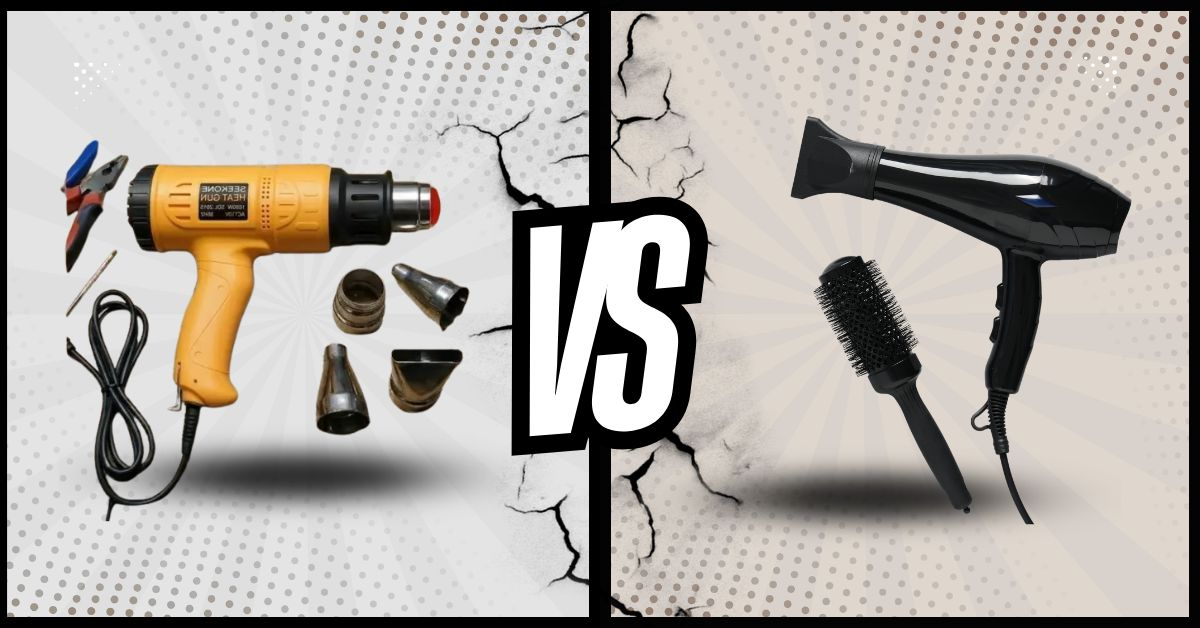
Pick up a heat gun and a hair dryer side by side. They look almost identical. Same shape, same trigger, same nozzle pointing forward. But one reaches 1,200°F and melts paint off walls. The other maxes out at 200°F and dries your hair after a shower. Confusing the two is not just a mistake. It is dangerous.
A heat gun is an industrial tool that produces concentrated heat between 200°F and 1,200°F+ (93°C to 650°C+) for tasks like paint stripping, vinyl wrapping, and pipe thawing. A hair dryer is a personal grooming device that produces diffused heat between 80°F and 200°F (27°C to 93°C) designed specifically for drying and styling hair safely.
The heat gun vs hair dryer question comes up more often than you might expect. Some men wonder if they can use a hair dryer for DIY projects. Others, worryingly, ask if a heat gun works on hair. Both answers matter, and both carry real consequences if you get them wrong.
HQ Barbershop offers a professional hair dryer service in Dallas that uses salon-grade blow dryers with controlled heat, trained technique, and premium products to style your hair without any risk of damage. In this blog, we’ll cover the full heat gun vs hair dryer comparison, explain why heat guns should never touch your hair, and show you how to blow dry properly as a man.
What Is the Difference Between a Heat Gun and a Hair Dryer?

They look the same. They are not the same. Not even close.
The difference comes down to three things: temperature, airflow, and purpose. Every other distinction, size, weight, noise, price, flows from those three.
Temperature Range Comparison
A standard hair dryer reaches between 80°F and 200°F (27°C to 93°C) depending on the setting and wattage. Most home dryers max out around 180°F on the highest setting. Professional salon dryers can push slightly higher, up to 230°F at close range.
A heat gun operates in a completely different universe. Entry-level models start at 200°F and climb to 1,200°F (650°C) or higher. Some industrial heat guns exceed 1,300°F. That is hot enough to melt solder, strip layers of old paint, and reshape plastic.
The gap between these two tools is not small. It is a 6x to 10x temperature difference. A hair dryer at full blast produces less heat than a heat gun on its lowest setting.
Airflow and Design Differences
Temperature is only half the story.
A hair dryer pushes air through a wide nozzle, spreading heat across a large area. This diffused airflow ensures no single spot on your hair or scalp receives too much concentrated heat. The design exists specifically to protect you.
A heat gun does the opposite. It channels air through a narrow nozzle, concentrating heat into a tight stream aimed at one spot. That focused delivery is exactly what industrial tasks need. Melting adhesive on a phone screen, shrinking tubing around a wire, or softening paint for scraping all require pinpoint heat.
But that concentrated stream on hair? It does not dry. It destroys.
Why They Are Not Interchangeable
A heat gun will burn your hair and scalp within seconds. The focused airflow at 400°F+ cooks hair from the inside out before the cuticle even has time to lift. Scalp burns happen instantly at these temperatures.
Going the other direction, a hair dryer cannot perform industrial tasks. It lacks the temperature and the focused airflow to strip paint, shrink wrap, cure resin, or thaw frozen pipes. You will burn out the motor long before the task is done.
Two tools. Two completely separate jobs. Treat them that way.
Can You Use a Heat Gun on Hair?
No. Not once. Not even to “just try it.”
This question appears online more often than it should. Some men see the similar shape and assume a heat gun is just a stronger hair dryer. That assumption can send someone to hospital with scalp burns and permanent hair damage.
What Happens to Hair at Heat Gun Temperatures
Hair keratin begins breaking down at approximately 300°F (150°C). A hair dryer never reaches that number. A heat gun blows past it on the lowest setting.
At 400°F to 600°F, the range most heat guns operate at for basic tasks, hair does not just dry. The water trapped inside each strand superheats and essentially boils. The hair cooks internally before the outer cuticle can release the steam. The result is hair that shatters, splits, and breaks off at the root.
The scalp fares even worse. Skin burns begin at roughly 130°F with prolonged contact. A heat gun at 400°F delivers that burn in under two seconds at close range.
Why Hair Dryers Are Engineered Differently
Hair dryers include multiple safety features that heat guns simply do not need and do not have.
Thermal cutoff switches shut the dryer down if internal temperature exceeds safe limits. Wide nozzle design spreads heat across a broader surface area, preventing hot spots. Multiple heat settings let you match temperature to your hair type. And the maximum temperature cap, around 200°F for home models, exists because engineers specifically calculated the threshold where hair stays safe.
Heat guns have none of these hair-safety features. They are built to deliver maximum heat to inanimate materials. Your head is not an inanimate material.
Heat Gun vs Hair Dryer: Complete Comparison Table
Here is the full heat gun vs hair dryer breakdown in one place.
Side-by-Side Comparison
| Attribute | Hair Dryer | Heat Gun |
| Temperature Range | 80°F to 200°F (27°C to 93°C) | 200°F to 1,200°F+ (93°C to 650°C+) |
| Airflow Type | Wide, diffused, gentle | Narrow, concentrated, intense |
| Wattage | 1,200W to 2,000W | 1,000W to 2,000W |
| Primary Purpose | Drying and styling hair | Industrial heating tasks |
| Safety Features | Thermal cutoff, cool shot, multiple settings | Overheat protection only |
| Nozzle Options | Diffuser, concentrator | Cone, deflector, scraper |
| Noise Level | Moderate | Loud |
| Safe for Hair/Scalp | Yes | No, causes burns and permanent damage |
| Price Range | $20 to $300+ | $20 to $200+ |
| Best For | Personal grooming | Paint stripping, shrink wrap, resin, repairs |
The wattage overlap is what confuses people. Both tools can draw 2,000W of power. But a hair dryer converts that power into high airflow at moderate heat. A heat gun converts the same power into extreme heat with lower airflow. Same energy input, completely different output.
Can You Use a Hair Dryer as a Heat Gun?

The reverse question. And the answer is: sometimes, barely, for very light tasks.
Light Tasks Where a Hair Dryer Works
A hair dryer can handle small, low-temperature jobs in a pinch. Removing adhesive stickers from surfaces. Softening candle wax for cleanup. Drying watercolour paintings without smudging. Lightly warming shrink wrap on very small items.
These tasks need gentle, low heat. A hair dryer delivers that. But the results will take longer and look less precise than a proper heat gun.
Tasks That Require a Real Heat Gun
Paint stripping needs 500°F to 1,000°F. A hair dryer cannot get there. Vinyl wrapping requires focused heat with precise temperature control. A hair dryer’s scattered airflow creates bubbles and wrinkles. Pipe thawing demands sustained high heat that will burn out a hair dryer motor long before the ice melts. Resin work needs a quick burst of intense heat to pop bubbles. A hair dryer blows dust into wet resin instead. Phone screen repair requires exact temperature to loosen adhesive without damaging components.
For any of these, you need an actual heat gun. A hair dryer is a grooming tool, not an industrial substitute.
How Hot Does a Hair Dryer Get and Why It Matters for Men
Now that the heat gun vs hair dryer comparison is clear, let’s focus on what actually affects your hair: the dryer you use every morning.
Most men never think about dryer temperature. They turn it on, blast it on high, hold it close, and wonder why their hair feels like straw by Wednesday.
Safe Temperature Range for Men’s Hair by Type
| Hair Type | Max Safe Temperature | Why |
| Fine and Thin | Below 140°F (60°C) | Dries fast, damages faster. Needs low heat only |
| Normal | 140°F to 160°F (60°C to 71°C) | Balances drying speed with protection |
| Thick and Coarse | 160°F to 180°F (71°C to 82°C) | Needs more heat but with constant movement |
| Colour-Treated | Below 150°F (65°C) | Heat opens cuticle and accelerates colour fading |
We covered dryer temperatures in much more depth in our guide on how hot does a hair dryer get. That post breaks down temperatures by wattage, setting, and distance from the nozzle.
Why Men Face Higher Heat Damage Risk
Three factors work against men specifically.
First, shorter hair. Men hold the dryer closer to the scalp because there is less hair length to work with. Closer distance concentrates more heat per square inch on both the hair and skin.
Second, maximum heat as default. Most men flip the dryer to the highest setting and leave it there. No adjustment for hair type. No cool shot at the end. Just raw heat until the hair feels dry.
Third, no heat protectant. Women’s grooming routines include heat protectant spray as standard. Most men have never used it. That missing barrier means every degree of heat hits bare, unprotected hair.
For professional blow-dry results with controlled heat matched to your hair type, our hair dryer service in Dallas handles all three of these factors for you.
How to Use a Hair Dryer Properly (Men’s Guide)
You now know the difference between a heat gun vs hair dryer. You know the safe temperature ranges. Here is how to actually use your dryer without causing damage.
Towel Dry Before You Blow Dry
Remove 60 to 70 percent of the water with a towel before you turn the dryer on. Pat the hair. Do not rub.
Less water on the hair means less time under heat. If you start blow drying soaking wet hair, you double the heat exposure required to finish. Starting with clean, properly washed hair also makes a difference. Product residue forces the dryer to work harder and longer. Our hair washing service in Dallas removes all buildup before drying, giving you a clean starting point.
If you are unsure how often to wash before drying, our guide on how often men should wash their hair covers frequency by hair type and lifestyle.
Distance, Movement, and Cool Shot
Hold the dryer 6 to 8 inches from your hair. Halving that distance roughly doubles the heat reaching the strand.
Keep the dryer moving constantly. Never hold it on one spot for more than three seconds. Treat it the way you would a torch lighting a path. After styling, hit the cool shot button for 30 seconds. Cool air closes the cuticle, locks the style, and adds shine. Most men skip this step entirely. It takes half a minute and makes your style last hours longer.
Product Application: Before or After Drying?
Heat protectant spray goes on damp hair before you start drying. It creates a barrier that reduces heat transfer to the cuticle.
Pomade, clay, and wax go on after drying. Blow drying over heavy styling products melts them into the hair shaft, creating stiff, waxy buildup that stops hair from moving naturally. Dry first, style second.
If you colour your hair, lower heat matters even more. Heat opens the cuticle and releases colour molecules with every drying session. We covered how heat interacts with colour-treated hair in our guide on does hair colour damage hair.
Why a Professional Blow Dry Beats Home Drying
Every man can improve his blow-dry technique at home. But a professional blow dry at a barbershop delivers results that home drying simply cannot match.
Better Tools, Better Technique
Salon-grade dryers offer 3 to 5 heat settings versus the 2 most home models provide. They generate higher airflow at lower relative heat, drying faster without cooking the hair. Professional nozzle attachments direct airflow with precision that consumer models lack.
But the biggest difference is the barber. A trained barber controls the angle of airflow relative to the hair shaft. Blowing air downward smooths the cuticle and eliminates frizz. Blowing air upward, which is what most men do at home, lifts the cuticle and creates roughness. That single angle adjustment explains why barbershop blow dries always look smoother.
Our Hair Dry Service at HQ Barbershop
At HQ Barbershop Dallas, our hair dryer service includes a volume-boosting blow dry for men who want texture and fullness, and a straight blow dry for a sleek, polished finish.
We match heat settings to your hair type, maintain proper distance and movement, and apply the right products in the right order. The result holds shape all day.
Pair it with a fresh haircut in Dallas and you walk out with a cut and style that work together. Add a colour treatment and we set the colour with controlled heat that protects your investment instead of fading it.
Many of our clients in Oak Lawn and Uptown Dallas add a blow dry to every haircut visit. It takes minutes and completely changes how the cut looks.
Frequently Asked Questions
Can a heat gun be used as a hair dryer?
No. Heat guns reach 400°F to 1,200°F+ with concentrated airflow that will burn hair instantly and cause severe scalp damage. They lack the safety features, diffused airflow, and temperature limits that hair dryers use to protect hair and skin.
What is the main difference between a heat gun and a hair dryer?
Temperature and airflow. Hair dryers reach 80°F to 200°F with wide, diffused air designed for safe hair drying. Heat guns reach 200°F to 1,200°F+ with narrow, concentrated air designed for industrial tasks like paint stripping and vinyl wrapping.
Can you use a hair dryer instead of a heat gun for shrink wrap?
Only for very small, light items. A hair dryer lacks the concentrated heat needed for proper shrink wrapping. Results will be uneven, take significantly longer, and risk burning out the dryer motor before the task is complete.
How hot does a hair dryer get compared to a heat gun?
A standard hair dryer maxes out around 200°F (93°C). A heat gun can exceed 1,200°F (650°C). That is a 6x temperature difference, which is why the two tools serve completely different purposes and should never substitute for each other.
Is blow drying bad for men’s hair?
Not if done correctly. Use medium heat (140°F to 160°F), hold the dryer 6 to 8 inches away, keep it moving, and finish with a cool shot. A professional blow dry at a barbershop controls all of these factors automatically, delivering better results with less damage.
Choose the Right Heat for Your Hair at HQ Barbershop
Heat gun vs hair dryer is not a close contest. One melts paint. The other styles of your hair. They share a shape and nothing else. Never mix them up, and never assume a heat gun belongs anywhere near your head.
As for your actual hair dryer, most men use it wrong. Too hot, too close, no protectant, no technique. Small adjustments, lower temperature, proper distance, a cool shot finish, protect your hair from damage that builds up silently over months.
HQ Barbershop offers a professional hair dryer service in Dallas with controlled heat, trained technique, and premium products matched to your hair type. Our barbers deliver volume-boosting and straight blow-dry finishes that last from morning to night without losing structure. Walk-ins welcome, or book your appointment for guaranteed availability. Also visit us through our Google Business Profile and let us create a fade that suits you from every angle.